
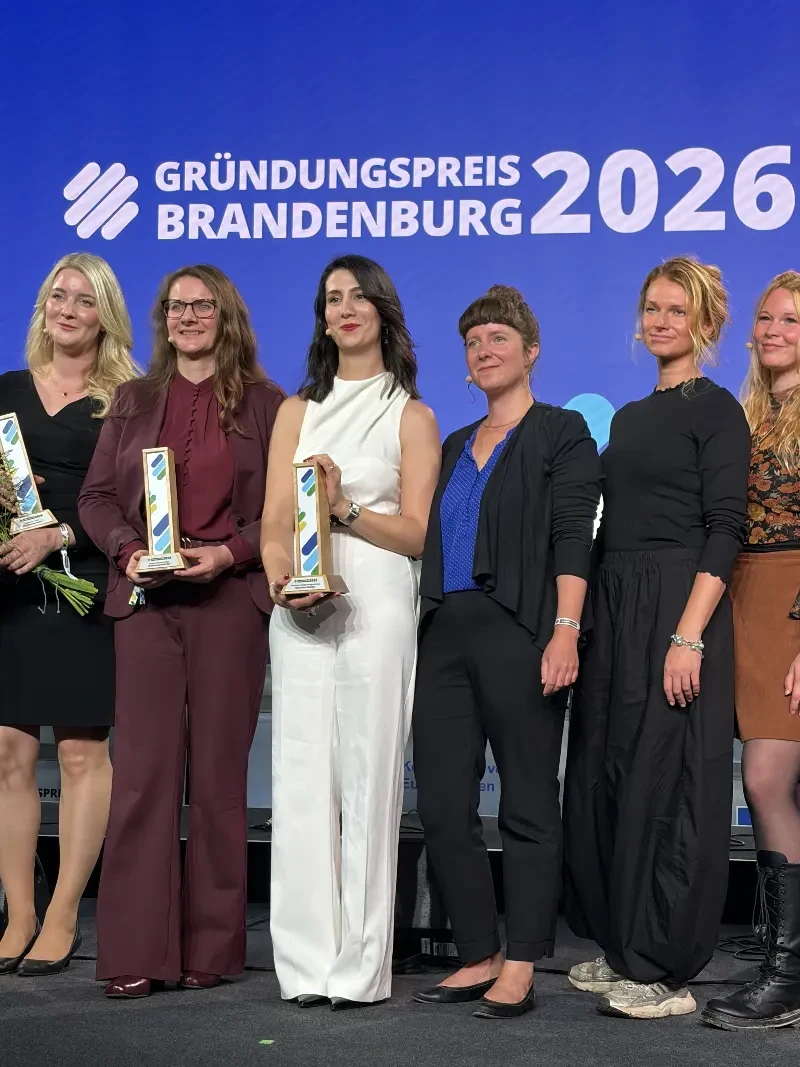
We are proud to announce that Ghazaleh Madani, Founder and CEO of CanChip, has received the Gründungspreis Brandenburg 2026 in the category “Gründung mit Migrationsgeschichte” (Entrepreneurship with a Migration Background).
The award was presented on September 2, 2026, at Biosphäre Potsdam as part of the Gründungspreis Brandenburg, which recognizes outstanding founders and entrepreneurial stories from across the state.
For Ghazaleh, this recognition carries a particularly personal meaning.
Born and raised in Iran, she completed her bachelor’s degree in Medical Laboratory Science before moving to Germany in 2020 to pursue a master’s degree in Biochemistry and Molecular Biology at the University of Potsdam.
Her scientific background, combined with her family’s personal experience with cancer, became part of the motivation to rethink how drugs and cancer therapies are tested during preclinical development.
During her studies, Ghazaleh connected with molecular biologist and geneticist Dr. Omid Nejati. Together, they developed the scientific and entrepreneurial foundation that would eventually become CanChip.
In 2023, shortly after completing her studies, Ghazaleh founded CanChip in Potsdam Science Park.
Today, our team develops advanced organ-on-chip and tumor-on-chip models that recreate human-relevant biological environments under controlled laboratory conditions. Our goal is to provide pharmaceutical, biotechnology, and research partners with more predictive tools for preclinical research and drug development while contributing to the development of alternatives to conventional animal models.
Receiving the Gründungspreis Brandenburg therefore represents more than an entrepreneurial award. It recognizes a journey from scientific education and personal motivation to entrepreneurship and the creation of a biotechnology company in Brandenburg.
It also reflects the importance of an ecosystem that enables international scientists and entrepreneurs to transform ideas into companies.
We are deeply grateful for this recognition and for the many people and organizations that have supported CanChip along the way—from universities and research institutions to customers, partners, funding organizations, and the startup ecosystem in Brandenburg.